

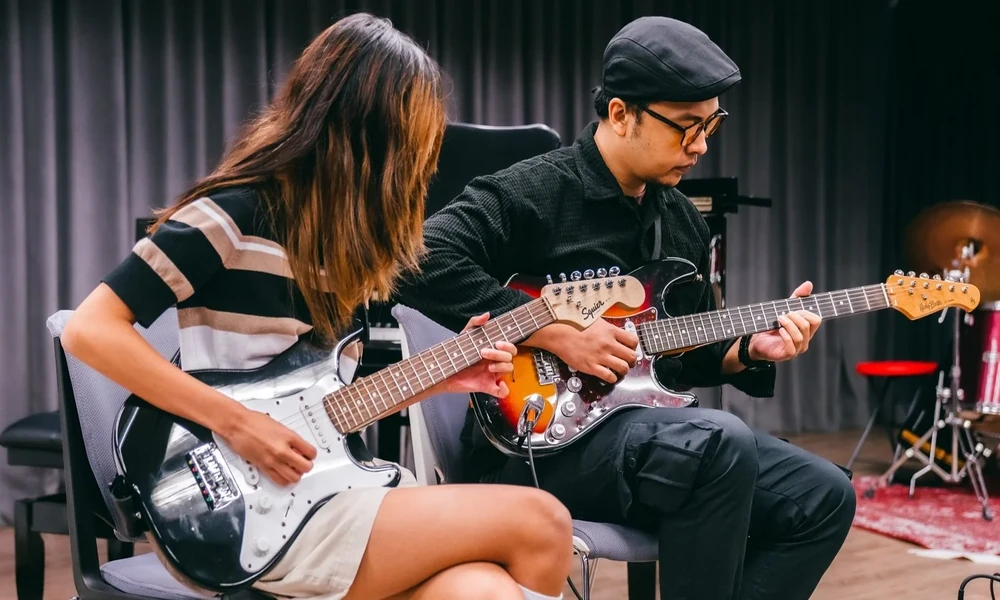
Electric guitar has a reputation as the easier route into playing, mostly because the strings sit lighter under the fingers than on an acoustic and the neck is often slimmer, which helps in the very first days. That reputation misleads beginners into expecting an easier road overall. The real early challenges on electric guitar are different, not smaller: bends and vibrato demand controlled finger strength, tone depends on amp and pickup settings a beginner has never touched before, and most repertoire is learned from tablature rather than notation. Choosing electric guitar lessons in Singapore that address these specific demands matters more than assuming the instrument itself does the easy work.
Why Electric Feels Easier but Isn’t Simpler
Lighter strings and lower action make basic chord shapes physically easier to hold down in the first week, which is where the easier instrument idea comes from. What that comparison misses is technique required beyond chords: string bending, palm muting, and controlled vibrato are electric guitar staples with no real acoustic equivalent, and none of them come from simply pressing strings down accurately. A teacher who treats early lessons as acoustic technique on a lighter instrument skips over skills a student will need within months.
Reading Tab Versus Reading Notation
Most electric guitar repertoire, from rock to blues to metal, is taught and shared through tablature, which shows finger placement but nothing about rhythm or note duration unless paired with notation or a recording. Standard notation reading is not strictly required to become a competent electric guitarist, unlike piano or violin, but a student who never develops any rhythmic reading ability will struggle to learn new material independently once formal lessons end.
What Gear You Actually Need to Start
A genuinely usable starter setup is a budget electric guitar, a small practice amp, and a cable, and none of it needs to be expensive in the first year. Effects pedals, a second amp, or an upgraded instrument are all worth delaying until the student has a clear sense of the tone and genre they actually want, since a beginner cannot yet judge what gear differences even sound like in practice.
Technique Priorities in the First Months
The technical foundation that actually pays off is fretting-hand pressure control, alternate picking accuracy, and basic palm muting, all of which transfer to every genre regardless of what the student eventually wants to play. A teacher who spends the first months on core technique that transfers across every guitar genre, rather than jumping straight into a favourite song, is setting up faster progress later even though it feels slower at the start.
Genre-Focused Teaching Versus Generalist Teaching
Some teachers specialise heavily in one genre, usually rock, blues or metal, and teach technique through that lens from the first lesson, which suits a student who already knows what they want to play. A generalist teacher covers broader technique first and lets genre preference emerge over the first year, which suits a student who is not yet sure what kind of music they actually want to make on the instrument.
How Amp and Effects Knowledge Factor In
Understanding gain staging, basic EQ, and what an effects pedal actually does to the signal is part of learning electric guitar, not a separate hobby, since tone shapes how playable a piece feels under the fingers. A teacher who never touches amp settings during lessons leaves a student unable to make their own instrument sound decent outside the lesson room, which quietly undermines motivation to practise at home.
Group Lessons for a Social, Band-Style Start
Some studios run small-group or band-style lessons where beginners learn to play together rather than solely one-to-one, which builds timing and listening skills that solo practice cannot replicate. This format suits a student motivated by playing with others more than by technical mastery, though it usually needs pairing with at least some one-to-one time to fix individual technique issues a group setting cannot address.
Setting a Realistic Timeline for First Songs
A motivated beginner practising most days can usually play a simple recognisable song within four to six weeks, though it will sound rough at tempo. Full command of a genre’s characteristic techniques, whether that is blues bending or metal palm-muted riffing, realistically takes closer to a year of consistent practice, and a teacher who promises faster mastery than that is setting expectations practice alone cannot meet.
What to Ask a Prospective Teacher
Ask what genres the teacher actually plays and teaches well, since enthusiasm for teaching does not always match depth in a specific style. Ask how much of a typical lesson covers technique versus repertoire, and whether amp and tone basics are part of the curriculum at all. A teacher who answers vaguely on any of these is likely teaching from a general songbook rather than a considered curriculum.
Choosing a Starting Point
Getting started with electric guitar lessons in Singapore works best when the gear stays modest, the technique comes before the favourite song, and the teacher’s own genre strengths roughly match what the student actually wants to play. None of that requires expensive equipment or an ambitious first-year target, just a realistic sense of what the instrument actually demands beneath its easier reputation.
